
Quotation vs proforma invoice vs tax invoice
What a quotation, a proforma invoice and a tax invoice are each for, the order they come in, and where advances and GST fit between them.
In this article
A buyer asks for your rates. Then their accounts team wants a "proforma" before releasing an advance. After delivery they want the "proper bill". These are three documents with three jobs, and mixing them up causes confusion about what is owed and when GST comes in.
Three documents, three jobs
- Quotation: an offer of what you will supply, at what price, and for how long the price holds. Nothing is owed.
- Proforma invoice: looks like an invoice but is sent before the supply, so the buyer can get approval or pay an advance. It is a commercial document, not a tax invoice, and does not replace one.
- Tax invoice: the document for the supply itself, with your GSTIN, the tax and the other fields the law requires. See how to make a GST invoice.
| Point | Quotation | Proforma invoice | Tax invoice |
|---|---|---|---|
| Purpose | Offer a price | Let the buyer approve or pay in advance | Bill the actual supply |
| When | Before the order | After the order, before supply | At the time the law sets for your supply |
| Does the buyer owe money? | No | No, unless they choose to pay an advance | Yes |
| GST | Shown as an estimate of the full price | Shown as an estimate | Charged |
| Numbering | Its own series | Its own series | The tax invoice series, unique within the financial year |
The order they come in
- 1Quotation. The buyer asks for a price. Send items, rates, GST and a valid-until date.
- 2Order. The buyer accepts, often with a purchase order number. Quote it on everything that follows.
- 3Proforma, if asked. Some buyers need one to approve the spend or release an advance.
- 4Advance, if any. If money comes before the supply, issue a receipt voucher for it (see the next section).
- 5Supply and tax invoice. Deliver the goods or the service and issue the tax invoice on time. See when a GST invoice must be issued.
- 6Payment. Collect the balance after any advance, as per your payment terms.
Where advances and GST come in
The point to watch is the advance. As of November 2026:
- Goods: no GST is payable when you receive an advance. The tax is paid when the invoice is issued. There are exceptions, including composition dealers, so check your case.
- Services: GST is payable on the advance. The time of supply is the earlier of the invoice date and the date the payment is received.
- Both: you issue a receipt voucher for the advance. It shows the amount, the rate, the tax and the place of supply. If the rate cannot be worked out yet, tax is charged at 18%; if it is not clear whether the supply is within the State or between States, it is treated as between States.
- If the deal falls through after an advance and no supply or invoice follows, a refund voucher is issued.
An example with goods. Say you agree to supply goods worth ₹2,00,000 to a dealer, and 18% is the rate that applies in this example. The dealer pays ₹50,000 in advance against your proforma. You issue a receipt voucher for the ₹50,000; because these are goods, no GST is payable on it then. When the goods go out, you issue a tax invoice for ₹2,00,000 plus ₹36,000 GST, ₹2,36,000 in all, and the dealer owes ₹1,86,000 after the advance.
Had this been a service, GST would have been payable on the advance when it arrived; work out that figure with your accountant. These rules are general information, so confirm them with your accountant or the official sources below before you act.
Quotations in InvoiceKaro, and what to do about proformas
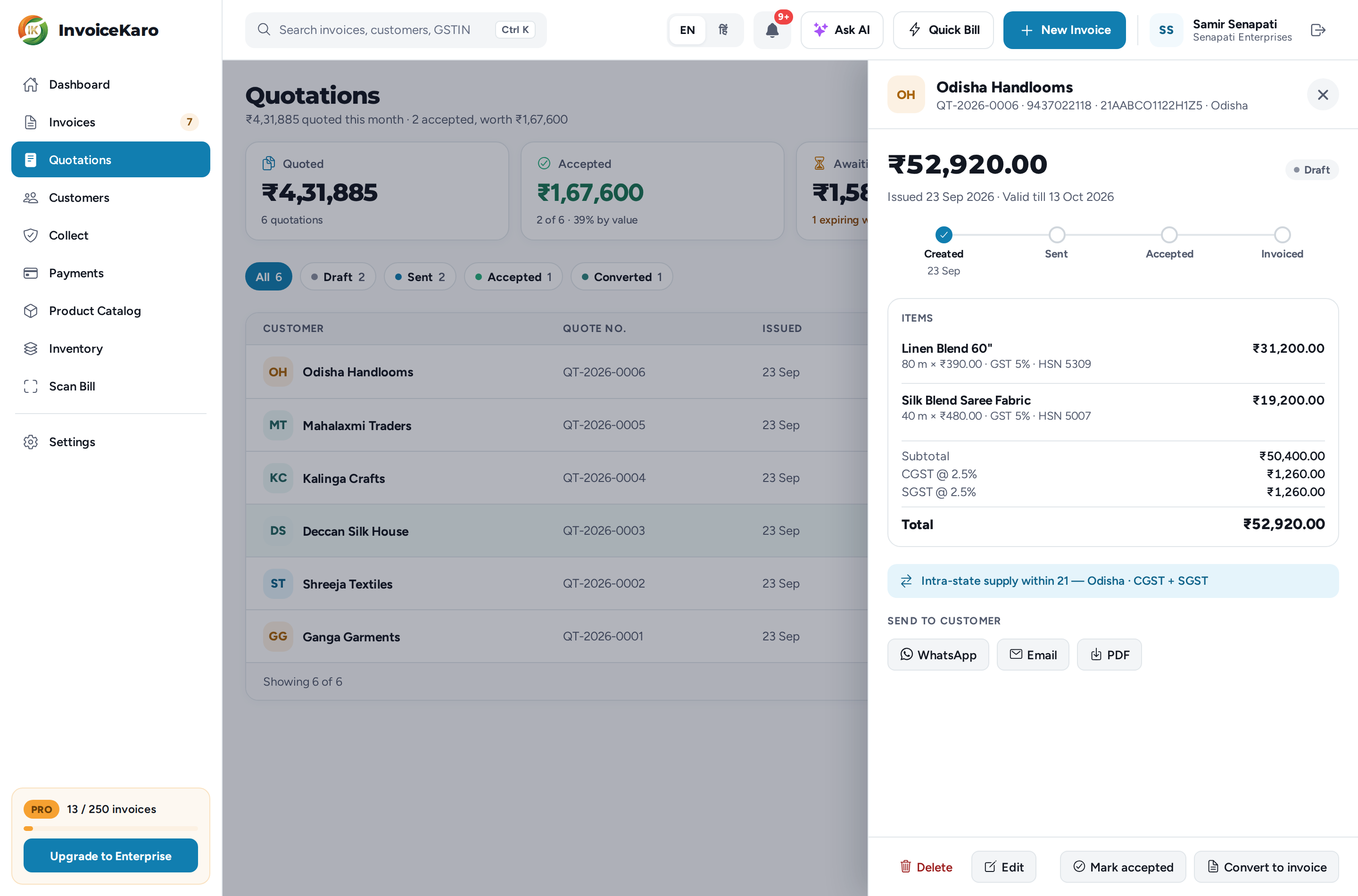
Quotations have their own financial-year series, QT-2026-0001 onwards, separate from invoices. Click New quotation, choose the Customer, set Valid until (7, 15 or 30 days, or a date), add items with Qty, Rate (₹) and GST %, and click Save quotation. GST is worked out the same way as on an invoice.
- Statuses: Draft, Sent, Accepted, Converted and Expired. A quote past its valid-until date with no acceptance is marked expired automatically.
- Sending: by email with the PDF, on WhatsApp (you attach the downloaded PDF), or as a PDF titled QUOTATION, with the validity date and no payment details.
- Converting: when the buyer agrees, click Mark accepted, then Convert to invoice. This creates a draft invoice from the same lines, once only. Send it or use Mark as sent to issue it.
Common questions
What is the meaning of a proforma invoice?+
Is GST charged on a quotation?+
Do I need a receipt voucher for an advance?+
Can I convert a quotation into an invoice in InvoiceKaro?+
Official sources
This article is general information for small businesses, not tax or legal advice. Rules and rates change, so check the official source or ask your accountant before you act on it. InvoiceKaro does not file GST returns or generate e-invoices or e-way bills.